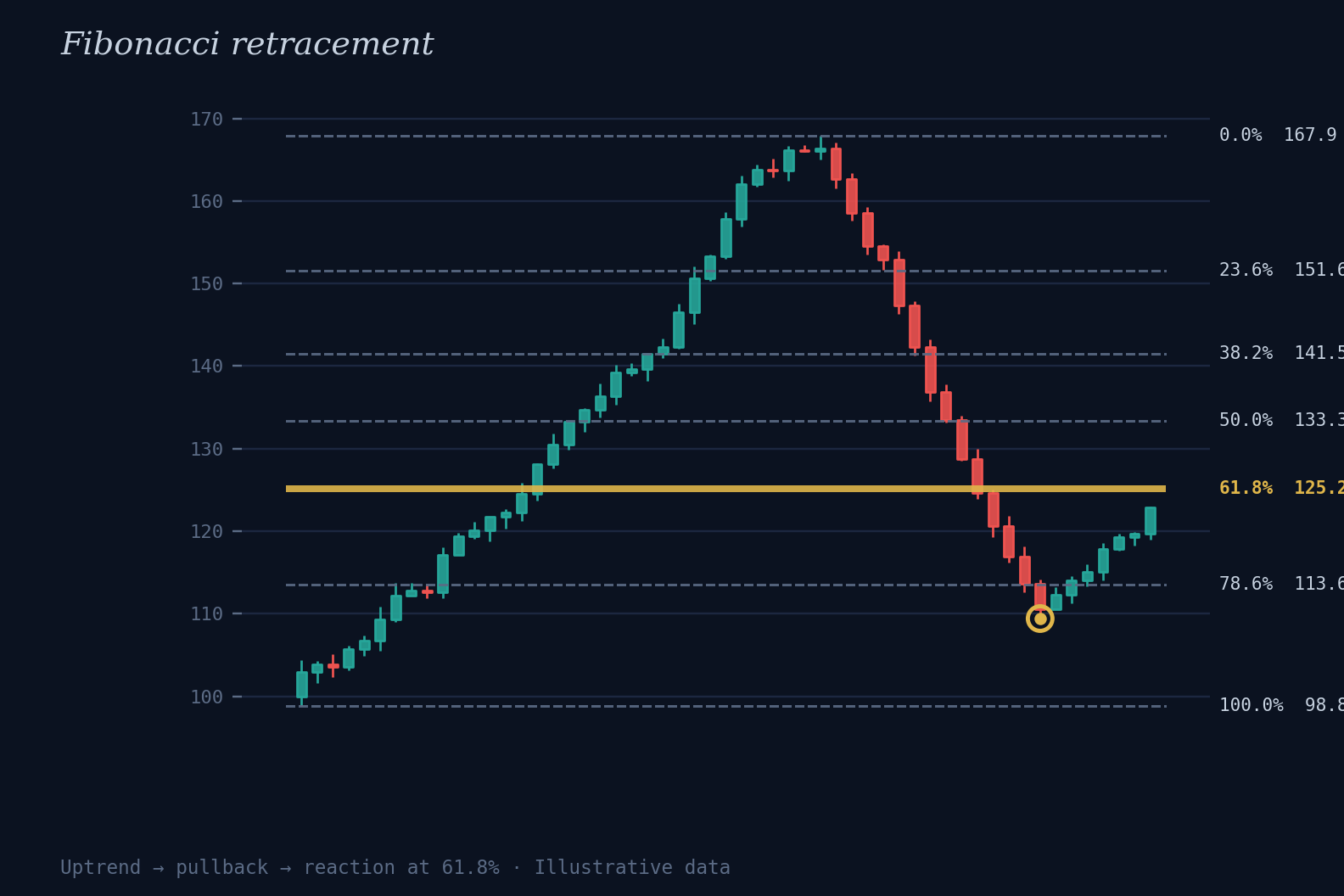
The market as a coordination game.
A technical support level doesn't predict anything on its own — it works as a Schelling focal point: a place where everyone expects everyone else to be looking.
Game theory studies decisions that depend on what others decide, who in turn decide by thinking about what you're going to do. It's not "games" in the recreational sense: it's any situation where the outcome of my move depends on yours. Pricing a product knowing competitors will react is a game. So is trading stocks, whether short-term or long-term.
In 1960 the economist Thomas Schelling proposed something simple and important: when two people need to coordinate without being able to talk to each other, they tend to converge on solutions that stand out for some reason, even if that reason has nothing to do with rationality. His classic example: if you tell two strangers to meet in New York City on the same day, with no way to communicate, most of them pick the clock at Grand Central Terminal at noon. Not because that place and that time are objectively "better," but because both know the other will probably pick it too, precisely for being the most obvious choice.
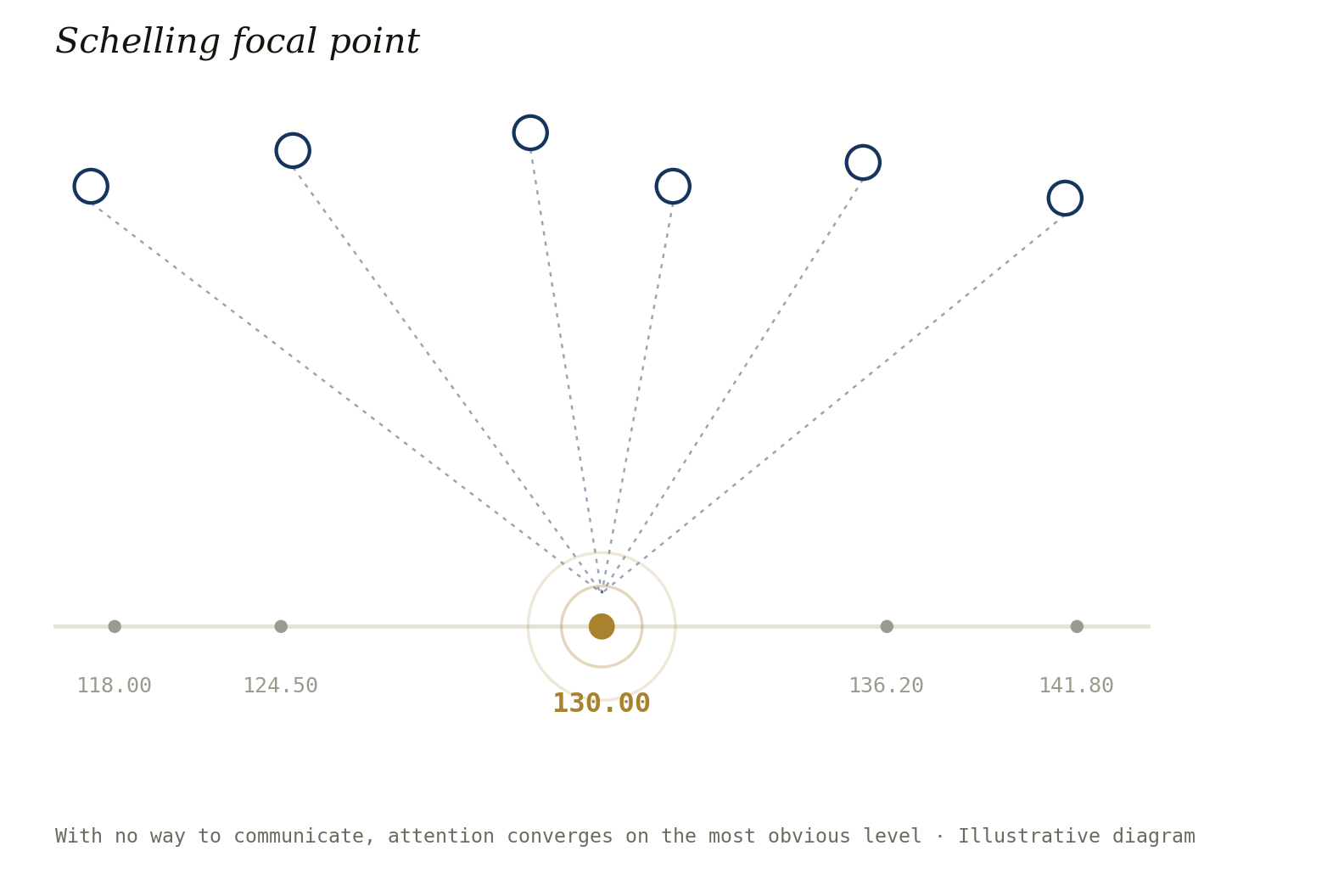
A technical support level at a round number, or one that coincides with a recent high, serves the same function: it's a focal point. It doesn't matter whether it makes any economic sense. What matters is that every participant knows everyone else is watching it too.
That's where an even finer concept comes in: common knowledge. It's not enough for me to know the support sits at a certain price. I need to know that you know it too, that I know that you know that I know it, and so on in a chain that in theory never ends. Once that knowledge is circulating, coordinating on that level stops being a gamble and becomes the rational move. I don't buy there because the price "respects" the line. I buy because I know everyone else is going to buy there too, and that alone is enough to move the price.
The shelf life of a known pattern.
If a pattern works because enough people know it, the more it spreads, the sooner it destroys itself.
Here's where things get paradoxical. If a pattern works because enough people know it and act on it, the more popular it becomes, the more people will try to get ahead of that mass reaction. And if everyone starts entering a little earlier to beat everyone else to it, the entry point keeps creeping earlier, until the original edge disappears.
It's the same logic as common knowledge, but working against itself: if I know that you know that I know about the support level, I have an incentive to buy before it arrives, not when it arrives. And if everyone reasons the same way, the pattern loses the very entry point that made it work in the first place.
MIT's Andrew Lo proposed the adaptive markets hypothesis: technical patterns work for a while, until enough participants adopt them and their edge erodes through the pattern's own widespread use.
There's no contradiction between "the market is efficient" and "some patterns work": efficiency simply isn't a fixed state, it's something that gets built and destroyed as strategies become widely known. Along the same lines, there's academic work on momentum (an asset's tendency to keep moving in the direction it was already moving) showing how it can behave as a self-fulfilling prophecy: if enough agents believe the recent past predicts the near future and trade on that belief, they end up generating exactly the move they expected.
When everyone piles in at once.
The same coordination that sustains the pattern in calm markets is what makes it fragile under stress — a crowded trade and a flash crash are the same coin seen from both sides.
There's a second side to this same phenomenon, and it's more dangerous than a simple loss of edge. When a large mass of participants reads the same signal, they don't just tend to trade in the same direction — they tend to do it at nearly the same time. That's known as a crowded trade.
While the market stays calm, that coordination is exactly what sustains the pattern. The problem shows up when something breaks it. If a lot of people are positioned on the same side expecting the same thing, and price moves the other way, the simultaneous exit of those positions can trigger abrupt, outsized drops — the kind you see in a flash crash.
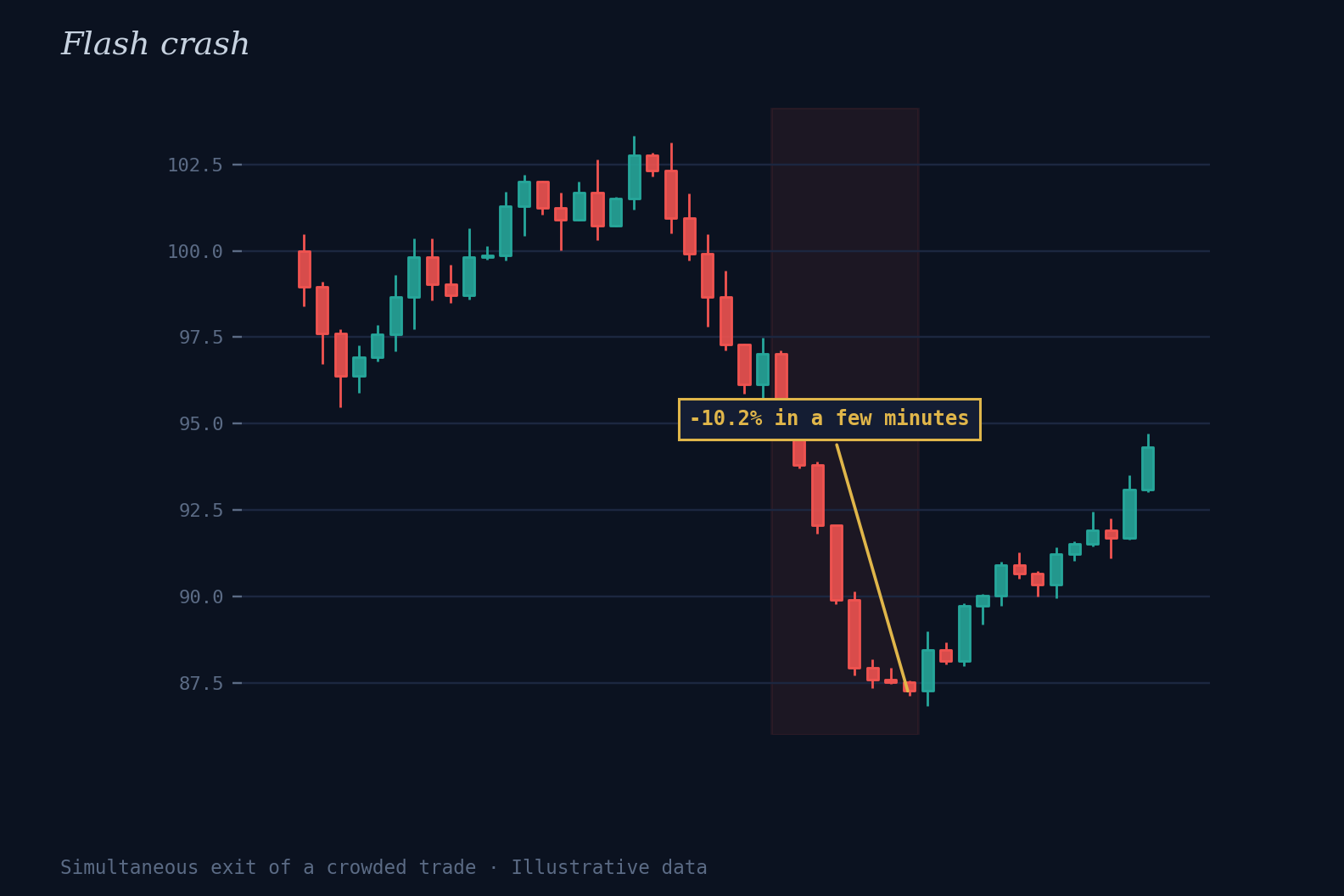
The same coordination that provides stability under normal conditions is what makes the system fragile under stress. These aren't two different phenomena: they're the same coin, seen from both sides.
The player who isn't playing the same game.
Once a pattern is widely known, it stops being a personal hunch: it becomes public information, exploitable by anyone with the capital, speed, and access to get ahead of it.
Up to this point, the whole argument assumes participants are more or less alike: everyone reads the same chart, everyone reacts with similar delays. But the market isn't homogeneous. Some actors have far more capital, faster execution, and better access to information than the average trader, and that asymmetry changes the game.
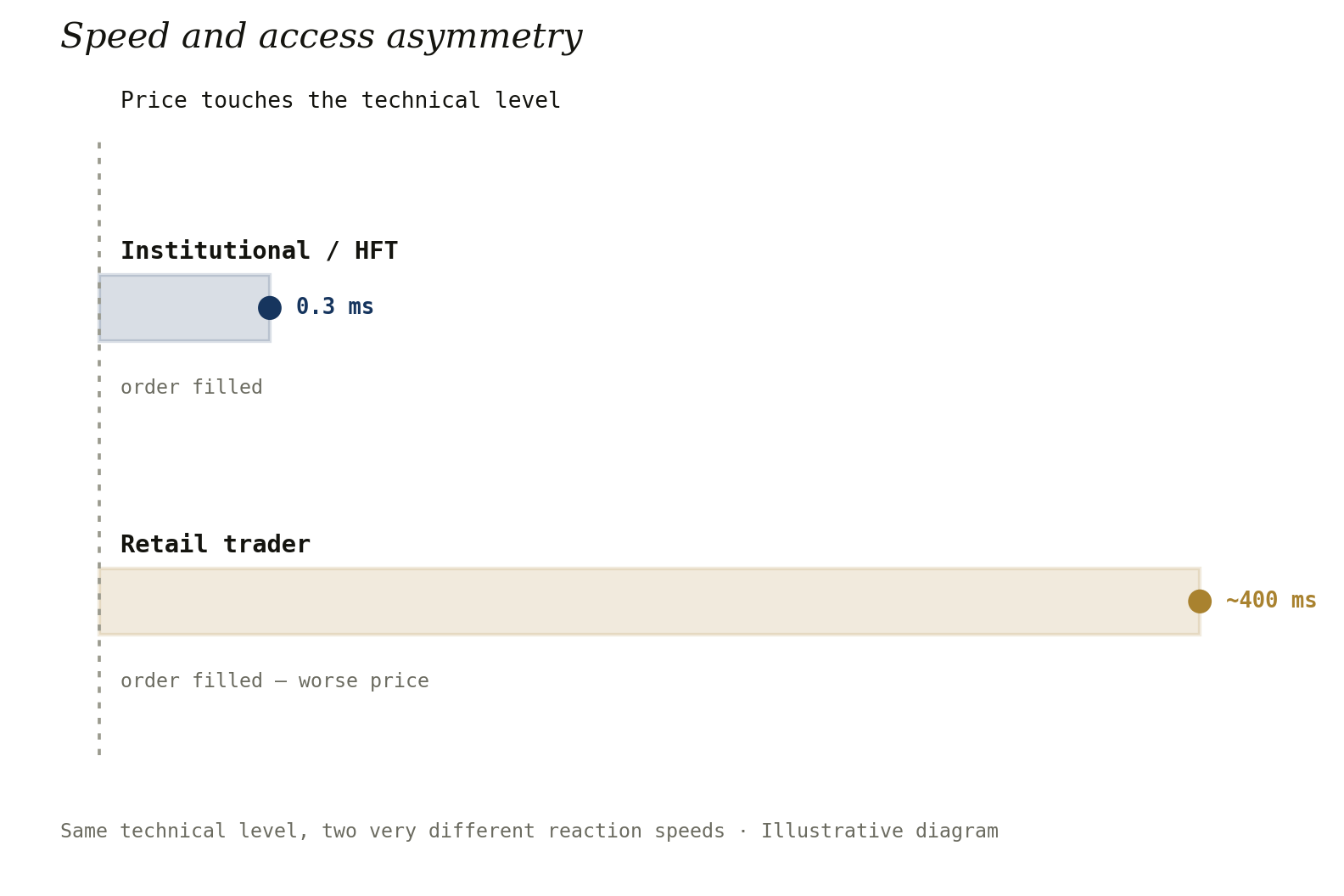
If a technical pattern is well-known and widely used, it stops being a personal hunch: it becomes public information, exploitable by anyone with the means to get ahead of the crowd's reaction. This requires no "malicious" intent, no secret coordination between funds. It only takes an asymmetry in information and speed, and it being rational to exploit it.
Market microstructure (the study of how prices form out of buy and sell orders) explains a good deal of this without needing to reach for conspiracies: any trader who needs to execute a large order has to go looking for liquidity, and the levels where most orders cluster — the famous support and resistance zones — are, quite simply, zones of high liquidity. Using them isn't cheating. It's the logical consequence of that being where the volume is.
The limits of this explanation.
The mechanism is plausible and grounded in serious literature — but some questions no theoretical argument can settle on its own.
It's worth being honest about what this framework can support and what it can't. Everything above describes a plausible mechanism, backed by serious literature in game theory and behavioral finance. But some questions remain open, and no theoretical argument alone can close them.
Without order-flow data, which is almost never public, there's no way to measure how many people are actually trading off a given technical level, nor to tell whether a bounce reflects coordinated belief among retail traders or a large player choosing to use that level as a reference for other reasons entirely. Institutional intent can't be proven from a price chart either — that's interpretation, not evidence. Any essay that leans on this idea has to draw a clear line between what's documented (focal points, common knowledge, the adaptive markets hypothesis) and where personal interpretation begins about why a particular level became relevant in a specific case.
That distinction doesn't weaken the argument. On the contrary — it's what separates an honest essay from a conspiracy theory with nice-looking charts.
Less exact science, more coordination.
Technical analysis doesn't predict the future through any magical property of the lines drawn on a chart. It works, when it works, because it coordinates enough people's beliefs that the coordination itself moves the price. And like any coordination built on shared knowledge, it has a shelf life: the more widely known a pattern becomes, the faster it tends to destroy itself, or the more attractive it becomes to whoever has the resources to get ahead of it.
Understanding this doesn't make technical analysis useless. It makes it more honest: less an exact science, more a study of how people coordinate when they can't talk to each other, with real money on the line.
Frequently asked questions
What is a focal point in game theory?
A focal point is a solution two parties converge on to coordinate without being able to communicate, not because it's objectively better, but because both know the other is likely to pick it for being the most obvious choice. Thomas Schelling formalized the idea in 1960 with the example of the clock at Grand Central Terminal at noon. A technical support level at a round number serves the same function on a price chart.
What is common knowledge in a market?
It's not enough for a trader to know where a support level is: they need to know that everyone else knows it too, and that everyone else knows that they know it, in a chain that in theory never ends. Once that knowledge is circulating, coordinating on that level stops being an individual bet and becomes the rational move for everyone.
What is Andrew Lo's adaptive markets hypothesis?
It's the idea, proposed by MIT's Andrew Lo, that technical patterns work for a while until enough participants adopt them and their edge erodes through the pattern's own popularity. It doesn't contradict market efficiency: it argues that efficiency isn't a fixed state, but something that's built and destroyed as strategies become widely known.
What is a crowded trade?
A crowded trade happens when a large mass of participants reads the same technical signal and trades in the same direction at nearly the same time. While the market is calm, that coordination is what sustains the pattern; if price moves against it, the simultaneous exit of those positions can trigger abrupt, outsized drops of the kind seen in a flash crash.
Does technical analysis predict future price?
Not through any magical property of the lines drawn on a chart. It works, when it works, because it coordinates enough people's beliefs that the coordination itself moves the price. Like any coordination built on shared knowledge, it has a shelf life: the more widely known a pattern becomes, the faster it tends to destroy itself.